
Florence Martin Garden
Public Education ProjectMy name is Grace Gerdenich, and I want to give you some background on what this project is and why it is so important. First, I am an undergraduate student at the University of Denver studying anthropology. Last spring (2025), I took an Introduction to Field Methods class with Dr. Bonnie Clark. In this class, we learned the basics of fieldwork and archaeological methods by conducting research at a site within Daniels Park. This site was the location of Florence Martin’s former summer home. The site had never been formally studied before and still requires further research.
While we were working at the site, one of the main focuses was on the gardens. The plants at the site were still growing in original garden beds once planted by Florence Martin herself. For my final project in the class, I focused on some of the prominent plants at the site and their historical background. I also discussed the cultivation and planting methods used by Florence Martin and what these practices can tell us about the gardens, Florence herself, and the land.
This winter, I enrolled in a course called Applied Heritage Management, where I learned about the legal and ethical aspects of archaeology and cultural resource management (CRM). For the final project in this class, we were required to create a product for a real cultural resource. I chose to focus on public education in relation to my earlier work. My project involves creating a webpage for the Denver Mountain Parks Foundation to help highlight and educate the public about some of the plants at the Florence Martin site.
Site Background
The site was occupied during the summers by Florence Martin from 1920 until 1937, when her summer home was burned down (National Park Service 1994). Today, the landscape contains a mix of native and nonnative plants that preserve the history of the estate once located on this land. During her time there, Florence cultivated many native plants and introduced nonnative plants from her travels. The remaining garden beds provide insight into how the space was used when she lived there.
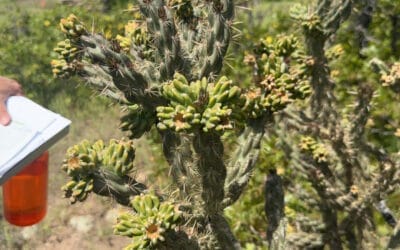
Our main interest during the first field session at this site focused on Florence Martin’s gardens and the types of plants she cultivated or introduced. It is known that she hosted garden parties at the estate, and the landscape reflected her extensive gardening skills. Many plants stood out during our work at Daniels Park, including ponderosa pines, cholla, catnip, boulder raspberry, lilac, tulips, iris, roses, and various wildflowers. For this project, I selected five standout plants to highlight and discuss their significance at the site on the Foundation’s webpage as a form of public educational material.


Project Bibliography
Harris, P., D. C. Zlesak, C. Carlson, and F. Ghavami. 2017. “Characterization of Rosa ‘Harison’s Yellow’ Clones Using SNP Markers.” In VII International Symposium on Rose Research and Cultivation, Acta Horticulturae 1232: 57–62.
Huckaby, Laurie Stroh, Merrill R. Kaufmann, Paula J. Fornwalt, Jason M. Stoker, and Chuck Dennis. 2003. Field Guide to Old Ponderosa Pines in the Colorado Front Range. Gen. Tech. Rep. RMRS-GTR-109. Fort Collins, CO: U.S. Department of Agriculture, Forest Service, Rocky Mountain Research Station.
National Park Service. 1994. National Register of Historic Places Registration Form: Daniels Park. United States Department of the Interior, 1994. Accessed March 16, 2026. https://npgallery.nps.gov/GetAsset/dac975e2-d68c-4394-a8cf-c8029200b4b5.
Rhoades, Heather, and Tonya Barnett. 2008. “Growing Tulips – Care and Tulip Planting Tips.” Gardening Know How, July 15, 2008. https://www.gardeningknowhow.com/ornamental/bulbs/tulips/tulips-care-and-tulip-planting-tips.htm.
ShunCy. n.d. “The Lifespan of a Cholla Cactus: How Long Do They Live?” Accessed March 16, 2026. https://shuncy.com/article/how-long-do-cholla-cactus-live.
Staughton, John. 2024. “9 Amazing Benefits of Catnip.” Organic Facts, May 3, 2024. https://www.organicfacts.net/health-benefits/herbs-and-spices/catnip.html.
The American Southwest. n.d. “Cylindropuntia imbricata, Tree Cholla.” Accessed March 16, 2026. https://www.americansouthwest.net/plants/cacti/cylindropuntia-imbricata.html.
Colorado State University Extension. n.d. “Catnip.” Adams County Extension. Accessed March 16, 2026. https://adams.extension.colostate.edu/horticulture/catnip/.